Rich Internet Applications and Content Management
In the mid-2000s, everyone seemed to be talking about Web 2.0. While the concept of collective intelligence, popularized by Tim O’Reilly, remained open to interpretation, one thing was becoming increasingly clear: the web was changing.
Web applications were beginning to resemble desktop software in terms of responsiveness and usability. This trend was spreading rapidly across the Internet, marking the arrival of a new generation of web applications known as Rich Internet Applications (RIA).
At the time, terms such as Web 2.0 and RIA became fashionable marketing labels. Many products adopted them without fully embracing the ideas behind them. So what exactly was a Rich Internet Application?
The Origins of RIA
The term Rich Internet Applications (RIA) first appeared in Macromedia marketing materials in March 2002. The company wanted to emphasize that Flash was more than a tool for visual effects. It could also serve as a platform for building complete business applications delivered through the web.
Traditional websites were primarily designed to present information. Their ability to support user interaction was limited compared to desktop software.
Every time a user navigated to another page or submitted a form, the browser had to reload the entire page. Besides being inconvenient, this process could also lead to data loss if the connection failed during the request.
This was the fundamental nature of what we now call Web 1.0.
A server received instructions when a user entered a URL or submitted a form. It generated an entirely new page and sent it back to the browser. The user then waited for the page to reload.
RIA applications introduced a different model.
Instead of reloading the entire page, the browser could communicate with the server in the background. When a user clicked a button or requested additional information, only the necessary data was transferred. A script running in the page received the response and updated the interface accordingly.
A More Responsive User Experience
Consider an online store built using traditional web techniques.
When browsing products, users might click a button labeled “Next 20 Products.” The browser would request a new page, wait for the server to generate it, and then replace the current page entirely.
In an RIA application, users could request products 50 through 80, filter by price range, or sort results dynamically. The page itself would remain visible while only the product list changed.
This made the experience feel much closer to using a desktop application.
Technologies Behind RIA
Several technologies emerged to support the development of rich internet applications:
- AJAX
- Adobe Flex
- Flash
- Windows Presentation Foundation (WPF)
- Java Applets
- Java-based frameworks
- Declarative languages such as XUL and MXML
Among these, AJAX and Flash achieved the broadest adoption.
Flash offered impressive capabilities but often required significant development effort and specialized skills. AJAX, on the other hand, could be integrated into existing web applications with relatively little overhead.
As a result, AJAX quickly became one of the driving forces behind the RIA movement.
AJAX and Asynchronous Communication
The name AJAX stands for Asynchronous JavaScript and XML.
Its core idea is simple: the browser and server can communicate asynchronously.
A browser no longer has to wait for a page reload before contacting the server. Likewise, the server can return data whenever needed without generating an entirely new page.
This opened the door to a wide range of interactive user experiences.
Drag and Drop on the Web
One of the most visible uses of AJAX was the introduction of drag-and-drop interfaces.
Users could move elements around a page just as they moved windows on a desktop operating system.
Personalized portal services and virtual desktop environments popularized this approach. Widgets could be rearranged, resized, and customized directly within the browser.
What once required desktop software was now possible inside a web page.
Rich Interfaces for Business Applications
These ideas quickly found their way into business software.
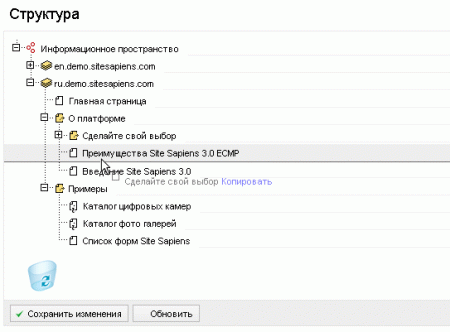
Portal users could customize their dashboards by dragging blocks into place. Content management systems began allowing administrators to rearrange page layouts without editing templates or configuration files.
Instead of relying on developers for every change, administrators could:
- Move content blocks using the mouse
- Resize interface elements
- Adjust visual presentation
- Save customized layouts
The same principles improved content management itself.
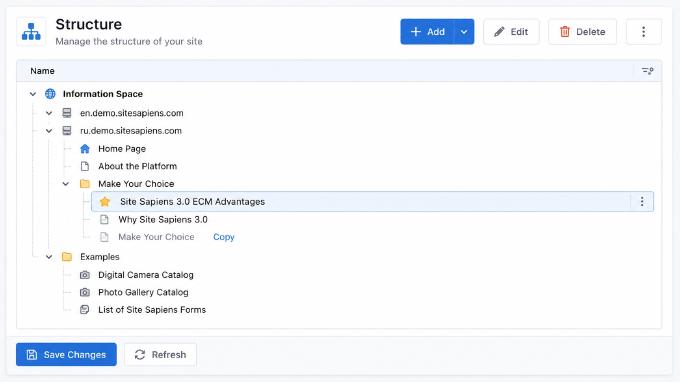
Moving a page within a site hierarchy became as simple as dragging it to a new location. Reordering items in a list felt much like moving files inside Windows Explorer.
Loading Data Only When Needed
Another major advantage of RIA architecture was lazy loading.
Applications no longer needed to transfer all available data during the initial page load.
For example, when displaying a site structure tree inside a CMS, only the first level might be loaded initially. Additional branches would be requested from the server only when the user expanded them.
The same approach proved useful for large datasets.
Rather than returning thousands of records at once, the application could load only the range currently requested by the user.
This improved both performance and usability.

Smarter Forms
Forms also evolved dramatically.
One notable innovation was the autocomplete field popularized by Google Suggest.
As users typed, the browser queried the server and displayed matching results immediately. This approach replaced many cumbersome dropdown lists that contained hundreds or even thousands of options.
The result was faster data entry and a significantly better user experience.
Reliability Improvements
Because page reloads were no longer required after every action, web interfaces could behave more like desktop applications.
Users could work with multiple forms, tabs, or sections of a page simultaneously and submit all changes together.
Equally important, applications could handle failures more gracefully.
If a network interruption or server error occurred, the interface could notify the user immediately and allow the operation to be retried without losing the entire page state.
This addressed one of the most frustrating limitations of traditional web applications.
Feedback and Process Visibility
RIA applications also introduced richer feedback mechanisms.
Users no longer had to wonder whether the system was working.
Loading indicators, progress bars, status messages, and notifications provided continuous feedback about ongoing operations.
If a product search was running, users could see that the request was being processed. If an error occurred, they could be informed immediately rather than being presented with a generic error page.
These interaction patterns are so common today that we often take them for granted.
Looking Forward
Rich Internet Applications brought web software significantly closer to the capabilities of desktop applications.
They improved usability, responsiveness, and reliability while introducing interaction models that were previously difficult or impossible to implement in a browser.
Perhaps most importantly, RIA technologies made it easier for web applications to communicate not only with their own servers but also with external systems and services.
This shift helped pave the way for modern web platforms, enterprise integrations, cloud applications, and eventually the highly interactive single-page applications we use today.
Looking back, many concepts introduced during the RIA era became standard features of modern web development. AJAX, asynchronous communication, dynamic interfaces, and real-time feedback are no longer innovations. They are expectations.
The web may have evolved far beyond the original RIA vision, but the foundations laid during that period continue to shape the applications we build today.